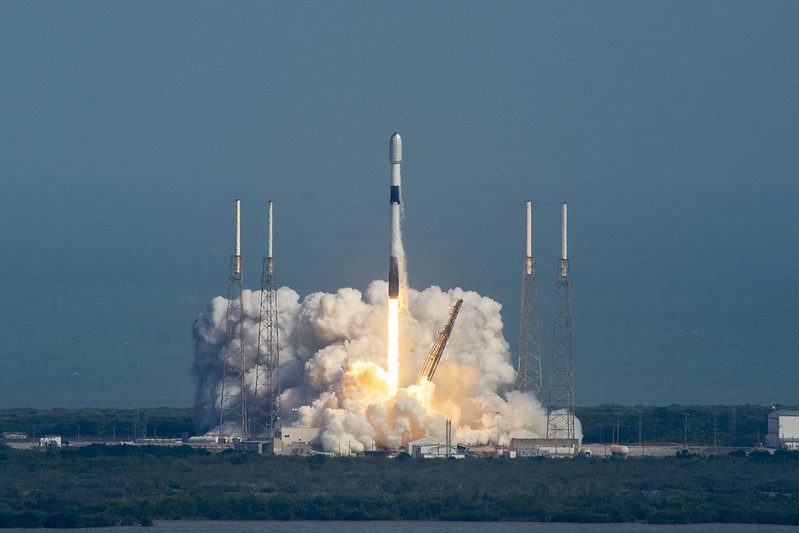
Today at 21:18 Bulgarian time, Falcon 9 is due to lift off from Vandenberg in California on the Transporter-18 mission, with a 58-minute launch window. On board are 130 payloads, among them a Google prototype for artificial intelligence in orbit. If the schedule holds, it will be Falcon 9's 110th flight of 2026 alone. On the same day SpaceX is also launching Crew-13, plus NROL-97 on Falcon Heavy from Florida, so for the first time in quite a while the company will use all three of its Falcon pads within 24 hours. We barely notice any more. Which, in itself, says a lot.
The payload looks more like a freight train than a space mission. According to SpaceX, it includes CubeSats, microsatellites, hosted payloads, two spacecraft with capsules for return to Earth and four orbital "tugs" that will deploy another 41 payloads later. Among the more interesting passengers is Starfish Space's first Otter, a spacecraft for servicing other satellites in orbit. The Google prototype is part of Project Suncatcher, through which the company is testing whether AI data centres can work in space. I admit that the idea of a server farm in orbit still sounds to me like something dreamt up at a corporate away day. But Google is evidently prepared to pay to find out.
Europe is out in force on board, which is almost ironic. Berlin-based Exolaunch will deploy 45 satellites, and D-Orbit, Planet Labs, OHB Italia, Satellogic and SEOPS all have payloads too, plus Finland's ICEYE with yet another radar satellite. In recent years the whole European small-satellite industry has been built on one and the same assumption: that once or twice a year there will be a cheap Transporter to sun-synchronous orbit. While Europe's small rockets are still chasing their first successful launch (we wrote about RFA recently), the continent's business flies on an American bus.
Now for the awkward part. SpaceX's megarocket is on the brink of a game-changing success, and that is exactly what is creating a crisis (or, as one of the most searched headlines on Google puts it, "SpaceX's megarocket is on the verge of paradigm-shifting success, it's spurring a crisis"). Starship reached orbit for the first time last week, and NASASpaceflight notes that missions like Transporter may not continue beyond 2028, as SpaceX gradually winds down Falcon 9 flights in favour of Starship. Nobody yet knows what rideshare on Starship will look like, at what price or how often. For the operator of a 10 kg CubeSat in Plovdiv or Helsinki, the difference between "there's a slot next month" and "wait for a 100-tonne rocket to fill up" could be the difference between a business and bankruptcy. Personally, I think this is the strongest argument for Europe's small rockets, stronger than every speech about sovereignty.
For those who follow the numbers: the launch is from SLC-4E to sun-synchronous orbit. Booster B1082 is flying for the 25th time, just 36 days after its previous flight, and will return to land at Landing Zone 4 next to the pad, so residents of Santa Barbara County will probably hear the sonic boom too.