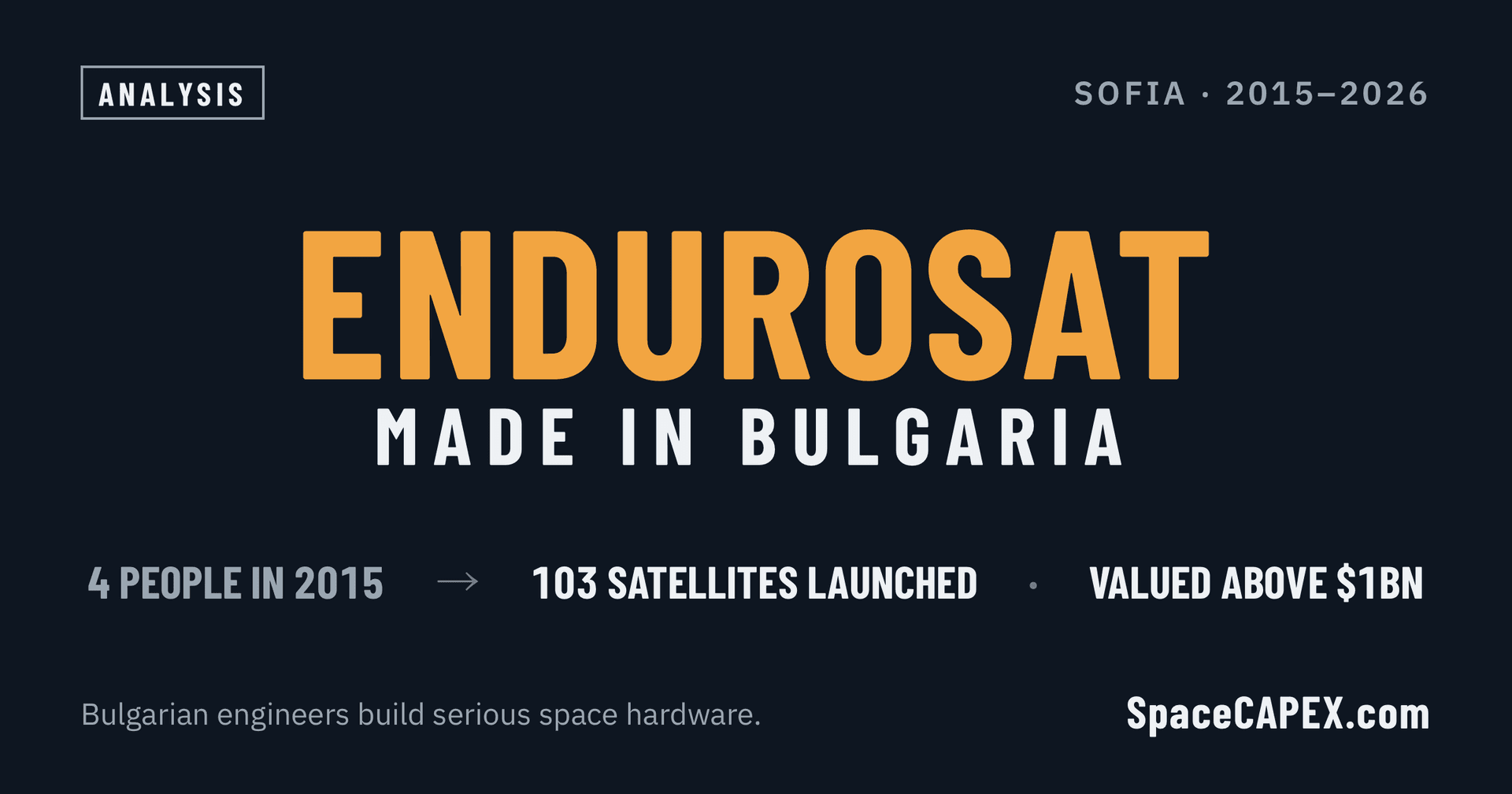
In January 2015 four people in a Sofia attic flat registered a company that wanted to build satellites. It sounds like the start of a joke (or of a startup pitch, which is sometimes the same thing). Eleven years later EnduroSat has more than 350 staff in seven locations, over 450 customers and 103 satellites launched. In September it became Bulgaria's second tech unicorn after Payhawk, with a valuation above $1bn.
I have spent nine years in manufacturing, so I look at EnduroSat a little differently from investors. The valuation is a nice number. What impresses me is something else: Sofia has a satellite factory that works, sells around the world and hires engineers. This piece is for people who have heard the name but don't quite know what the company does. And why it matters even to those of us who will never build a satellite.
What EnduroSat does, in short
Every satellite has two parts. One is the payload: the camera, radar or sensor that someone pays the mission for. The other is the platform that carries it: power and solar panels, an onboard computer, a radio to talk to Earth, and a system that keeps the satellite pointing the right way. EnduroSat mainly makes the second part.
The car comparison is almost exact. The company builds the chassis and the engine, and the customer decides what goes on top (a camera for farming, an antenna for connected devices or a reconnaissance sensor). EnduroSat also sells individual modules, and it can take on the whole mission: from assembly through launch to operations in orbit. The customer pays a fixed price and gets data without running a space department of its own. The company calls this "constellations as a service".
How it began: school first, company second
The story really starts five years earlier. Raycho Raychev returned to Bulgaria in 2010, convinced the country needed to grow its own space talent, and founded the Space Challenges academy, which has trained more than 600 people. "Everyone who joined at first came from our own education programme," he says. The reason is simple and a little sad: at the time Bulgaria had no other programme preparing students for the space sector.
The first satellite came three years after the company was registered. EnduroSat One, a CubeSat with 10 cm sides, flew to the International Space Station on 21 May 2018 and was deployed into orbit from there in July. It was Bulgaria's first CubeSat, an amateur radio mission. The business was modest then: for 2019 the company reported revenue of 2.04 million leva (about €1m) and a profit of 194,000 leva.
How it grew
The following years were a series of steps, each a little bigger than the last.
In 2021 EnduroSat launched SPARTAN, the first mission of its Shared Satellite service: one CubeSat carrying seven payloads for different customers, who split the cost. The same year the European Investment Bank gave it a €10m loan, the first venture debt deal in Bulgaria under the European Guarantee Fund. A little earlier the Neo Ventures fund had put in €2m at a valuation of close to €50m. Remember that number.
In 2023 came a $10m Series A and a 3,200 m² plant where the company could assemble, test and deliver ten CubeSats a month. Then the pace picked up sharply. In 2025 alone EnduroSat closed three rounds: €20m in February, €43m in May and $104m in October. The May round was led by Peter Thiel's Founders Fund, and the fund's partner Delian Asparouhov, who has Bulgarian roots, played an active role in the deal. With the October money the company opened a 17,500 m² Space Center on Tsarigradsko Shose boulevard, about 5.5 times the size of the old plant. At full capacity it can turn out up to two 200–500 kg satellites a day.
In 2026 the news has come almost monthly. In January the government named the centre a priority investment project, with about €11m of investment and 50 new jobs. In July the company passed 100 satellites in orbit. In August a space and defence hub was launched on the site of the old Dobroslavtsi airfield, to be built by Starbase Europe, another company owned by Raychev. The first phase runs for three years. And on 16 September EnduroSat announced $205m (about €178m), the largest funding round ever raised by a Bulgarian company, led by the US investors Riot Ventures and Atreides Management.
The chart shows something curious. Since the Series A each round has been roughly twice the size of the one before: €9m, €20m, €43m, €90m and €178m. That adds up to about €340m in three and a half years. The valuation, close to €50m in 2021, is now above $1bn, more than 17 times higher in five years.
Revenue is growing more slowly than the valuation, but it is growing. Preliminary figures put it at €34–35m for 2025, up more than 55% on the year before and more than 30 times the 2019 level. Raychev expects it to double in 2026 on the back of deals already signed.
What it sells
The products fall into three groups.
Modules. Onboard computers, UHF, S-band and X-band radios, power systems, solar panels, antennas and structures. The company sells them separately, including to other satellite makers. According to EnduroSat, more than 400 of its power modules, over 590 CubeSat structures and over 80 onboard computers are flying. In total there are more than 3,500 of its modules in orbit.
CubeSats. Small standard satellites in 8U and 16U sizes, where U is a 10 cm cube. They made the company's name.
FRAME. The new line of larger ESPA-class satellites, which fly as secondary payloads on a rocket. FRAME S is in the 200 kg class and FRAME L in the 500 kg class, while FRAME Max is designed for 1 to 5 tonnes, according to the company. This is where the money from the last two rounds is going.
Production is designed like an assembly line. The satellites are software-defined and their modules connect without cable harnesses, so one technician can assemble and test a complete satellite in eight hours, the company says. As a manufacturing person I will keep some doubt until I see the line myself. The direction is right, though: standardisation, repeatability, volume. Raychev's end goal is to bring the cost of data from orbit down to about $1 per gigabyte, from hundreds of dollars today.
Who buys
More than 450 customers, almost all outside Bulgaria. According to the government, all of its output is exported, mainly to the EU, the US and Japan. The two biggest orders announced this autumn are American.
Vantor, formerly Maxar Intelligence, picked EnduroSat for the buses of 24 satellites in its new Pulse constellation. Each will weigh about 400 kg and image at 40 cm resolution, and the constellation will be able to revisit the same spot every 15 minutes. Launches run from 2027 to 2029. The cameras come from the US company CACI, and integration and testing will take place in the United States.
TrustPoint has ordered 40 satellites for an alternative navigation constellation, a sort of backup to GPS.
Who pays
| Who pays | For what | How much | Source |
|---|---|---|---|
| European Investment Bank | Loan for growth and the Shared Satellite service (2021) | €10m | EIB |
| Founders Fund (lead), CEECAT Capital, Morphosis Capital | Round for ESPA-class satellites and the new centre (May 2025) | €43m | SpaceDaily |
| Riot Ventures, GV, Lux Capital, European Innovation Council Fund, Shrug Capital | Round for the Sofia Space Center (October 2025) | $104m | European Spaceflight |
| Riot Ventures and Atreides Management (leads), EIC Fund, GV, Founders Fund, Lux, Omnes, House, Giant, Emphatic, Endeavor Catalyst | Serial FRAME production, a US factory, a hub in Bulgaria (September 2026) | $205m | EnduroSat |
| Vantor | Buses for 24 Pulse satellites | Value not disclosed | Satellite Today |
| TrustPoint | 40 satellites for alternative navigation | Value not disclosed | Satellite Today |
| EnduroSat, with institutional support from the government | R&D centre (priority investment project) | About €11m | Bulgarian government |
Some of the money is European and public (the EIB and the EIC Fund), but most of it comes from private funds, mainly American. The Bulgarian state offers institutional support, not cash.
What EnduroSat proves about Bulgaria
This is the important part. Not because EnduroSat is a miracle, but precisely because it isn't.
The basic conditions have been in place for years. Corporate tax is 10%, one of the lowest in the EU. Since 1 January 2026 the country has been the 21st member of the euro area, so foreign investors no longer carry currency risk. Labour is cheap: an hour of work costs €12, against an EU average of €34.9, about a third. (That is both an advantage and a problem. More on the problem in a moment.)
The engineers are here, and not only men. Women make up 27% of ICT specialists in Bulgaria, the third-highest share in the EU, against an average of 19.5%. There are precedents, too. The US company Progress bought Sofia's Telerik for $262.5m in 2014, and Payhawk became Bulgaria's first unicorn in 2022. EnduroSat is the second. And the first whose product you can hold in your hands.
An ecosystem is growing around the company. Since the end of 2025 local firms in the sector have formed a cluster, and companies such as Wiser Technology already have roles in European space projects.
The state, however, is almost absent from this story. Bulgaria is only an ESA Cooperating State, and over ten years Bulgarian organisations have completed 53 projects worth just over €10m. EnduroSat's latest round is almost 18 times that, in a single deal. Raychev also had to train his first hires himself. And cheap labour has a flip side: it attracts investors, but it also pushes engineers towards better-paid places.
What still has to be proven
Being positive does not cancel the questions.
- Capacity versus actual output. In May 2025 the company set a target of up to 60 satellites a month by the end of 2025. There is no public data on actual volumes. 103 satellites launched in eight years is a solid achievement, but not yet an assembly line.
- The heavy satellites are still to come. FRAME is the new line, and Vantor's first satellites will not fly until 2027.
- Part of the growth will happen in the US. The new factory will be there because American defence customers require it, and the money is mostly American.
- The valuation is ahead of revenue. More than $1bn against €34–35m of revenue means investors are paying for the future, not the present.
My take
EnduroSat does not prove that Bulgaria is a space power. It proves something more useful: that a serious technology company can be built here, in hardware and not just software, and that it can sell to the most demanding customers in the world. The engineers were here all along. What was missing was a job big enough for them.
The recipe is no secret: education before business, European money at the start, American capital for scale and a lot of patience (eleven years since registration, about sixteen since the first academy). None of it is reserved for Sofia. That is why I hope EnduroSat will not remain the only example. If a satellite factory can be built on Tsarigradsko Shose, the problem was never the engineers.