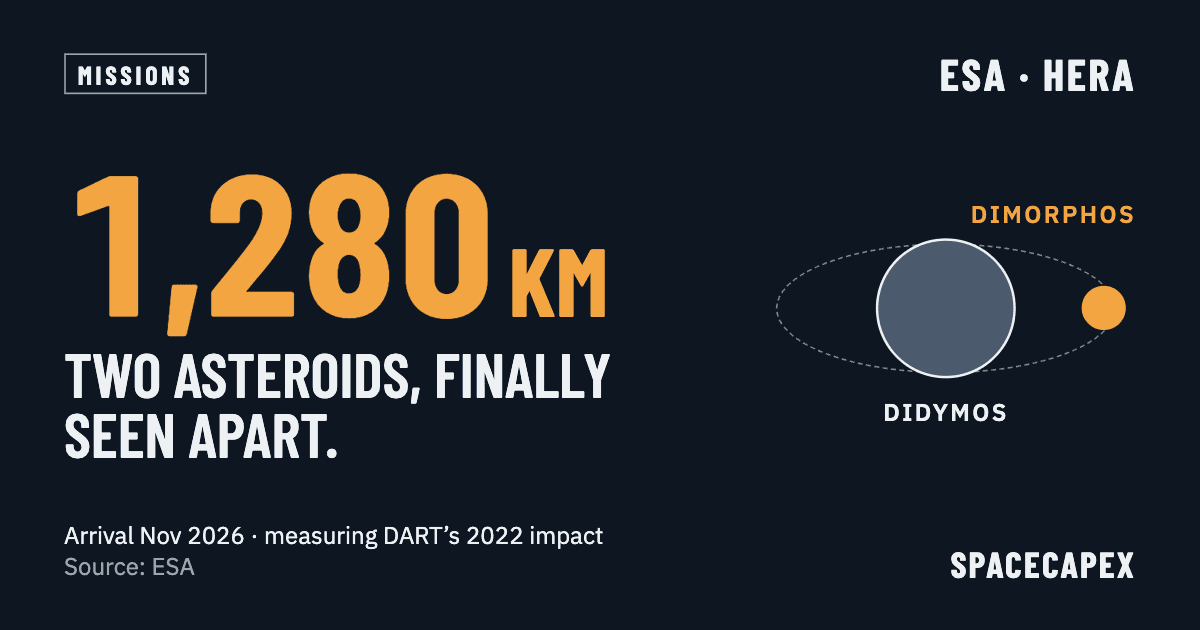
On the evening of 18 October, the Asteroid Framing Camera on ESA's Hera probe captured, from 1,280 km, something that until then had been a single point of light: the asteroid Didymos and its small moon Dimorphos, seen as two separate objects for the first time. According to ESA, Dimorphos covers about one pixel of the image. It is hardly a spectacular picture, but it is the first proof that Hera sees its target as it really is: two bodies, not one.
"With this image the smaller Dimorphos asteroid becomes visible for the first time," said ESA's Michael Kueppers. Mission manager Ian Carnelli was more effusive: for the first time, the team is seeing the double asteroid system "through Hera's own eyes".
A single point 151 metres wide
Dimorphos is 151 metres across, about one and a half football pitches. Didymos is 780 metres wide. The two sit on average 1.15 km apart, and Dimorphos circles its larger partner at around 18 cm/s, roughly eight times slower than a person out for a stroll. The whole system is about 197m km from Earth.
| The double asteroid in numbers | |
|---|---|
| Didymos, diameter | 780 m |
| Dimorphos, diameter | 151 m |
| Average distance between the two | 1.15 km |
| Dimorphos' orbital speed | about 18 cm/s |
| DART's speed at impact | 6.1 km/s |
| Change in orbital period after the impact | about 33 minutes |
| Distance from Earth (October 2026) | about 197m km |
Why Europe is chasing an asteroid NASA has already hit
On 26 September 2022, NASA's DART spacecraft slammed into Dimorphos at 6.1 km/s. The impact threw debris more than 10,000 km and cut Dimorphos' orbit around Didymos by about 33 minutes. The effect was larger than simulations had predicted. DART was destroyed at the moment of impact, so nobody has seen up close what was left behind.
That is where Hera comes in. ESA calls its job a "crash site investigation". The probe is meant to show whether the impact left a crater or reshaped the whole asteroid, to measure Dimorphos' mass, internal structure and composition, and to explain why the deflection was larger than expected. Without Dimorphos' mass, DART's impact is just an impressive experiment. With it, it becomes a formula: how hard you need to hit an asteroid of a given size to shift its orbit by a given amount.
What comes next
In October Hera fired its thrusters twice, a week apart, slowing to 20 m/s relative to the asteroids. ESA says it will arrive in November, a month earlier than originally planned. The first detailed images of Dimorphos are due to be released on 25 November.
Months of close-up study will follow. Hera will release two shoebox-sized CubeSats. Milani is operated by Tyvak in Italy. Juventas is operated by GomSpace in Luxembourg and carries a radar to look inside the asteroid. A landing attempt is planned at the end.
Who pays
Hera is part of ESA's Space Safety programme. The programme is optional, so only the countries that sign up pay for it. In 2020 ESA signed a €129.4m contract with Germany's OHB to design, build and test the spacecraft. Seventeen ESA member states and Latvia take part in the mission. Bulgaria is not among them.
| Who pays | To whom | For what | How much | Source |
|---|---|---|---|---|
| ESA member states (Space Safety programme) | OHB System AG | Design, manufacture and testing of Hera (2020 contract) | €129.4m | Mönch, Portugal Space |
| Portugal (via ESA) | Efacec, GMV Portugal, Synopsis Planet | Altimeter, autonomous navigation, laser microchip | €2.8m | Portugal Space |
| ESA member states | ESA, Space Safety domain | Space safety missions in 2026, including Hera | €199m | ESA |
Our view
A single dot in an image taken from 1,280 km is the humblest "first light" ESA has shown in years, which is exactly what makes it endearing. Hera is not a mission for pretty pictures but for one number: how efficiently an impact like DART's moves an asteroid. That number turns planetary defence from a one-off experiment into an engineering problem with a budget you can actually calculate.
Planetary defence is also one of the few fields where the division of labour with NASA works without drama: the Americans hit, the Europeans measure. The €129.4m contract is small next to Galileo, but it gives OHB, GomSpace and the rest deep-space experience they will soon need. The next mission along these lines, Ramses, has to reach the asteroid Apophis before its close pass by Earth in April 2029. Ministers confirmed it in Bremen. Now it has to be built on time, because Apophis will not wait for the next ministerial meeting.