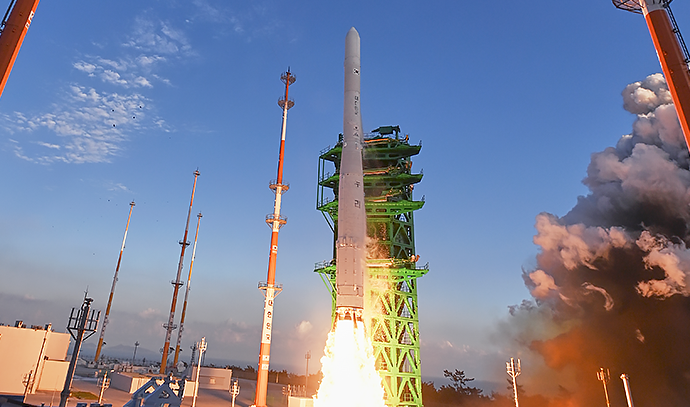
South Korea's Nuri rocket has been under assembly since late June at the Naro Space Center in Goheung, on the peninsula's south coast. If the schedule holds, it will be rolled out to the pad on 6 October and lift off in daylight on 7 October. The fifth flight has already slipped once because of engine tests on one of the satellites, so the Koreans are clearly in no hurry. Given a payload like this, you can see why.
There will be 15 satellites on board, more than ever before. The primary payload is five microsatellites
(numbered 2 to 6), each under 100 kg, developed by the satellite technology centre at KAIST together with Satrec Initiative. Their cameras deliver black-and-white images at 1-metre resolution and colour at 4 metres. Nothing dazzling by commercial standards. But for a constellation whose job is to watch wildfires, floods and (naturally) the northern border, it is plenty. The NEONSAT-1 prototype flew in April 2024, five more will follow on the sixth flight next year, and once all ten are in orbit Korea will be able to image the peninsula more than three times a day and revisit the same spot within 24 hours.
This is the first time the country has launched several primary satellites at once, and here comes the most delicate bit of engineering. After the third stage shuts down its engine at around 575 km, the five NEONSATs will be released one at a time at intervals of 35 to 40 seconds, using separation mechanisms designed to minimise shock. KARI specialists have also drawn up a space-object avoidance zone, an ellipse 200 km long and 50 km wide, which they will use to fix the exact launch time. Fifteen objects released almost simultaneously can easily turn into a billiard table if someone is off by a few seconds.
The secondary payload of ten CubeSats (the same little cubes we wrote about recently) is more colourful than the word "secondary" suggests. Space Liintech will test AI on board BEE-1012 that monitors and controls the crystallisation of drug compounds; its previous satellite, on the fourth flight, studied compounds for cancer treatment. Start-up Quaternion will hunt for marine debris around Jeju and the south coast, and a KARI platform will check whether SK hynix DRAM and UFS chips can survive the space environment. My favourite passenger, though, is DaejeonSat-1, the satellite belonging to Daejeon's city government. While plenty of European councils are still arguing over pavement repairs, one Korean city has its own spacecraft in orbit.
For me, the most interesting thing is the direction of travel. Last November's fourth flight handed a bigger role to the private sector. The fifth is already building a national constellation with its own rocket, its own satellites and its own chips. Europe is still waiting to see whether its small rockets will even make it to the pad. Seoul, meanwhile, is calmly planning which constellation to top up next year.