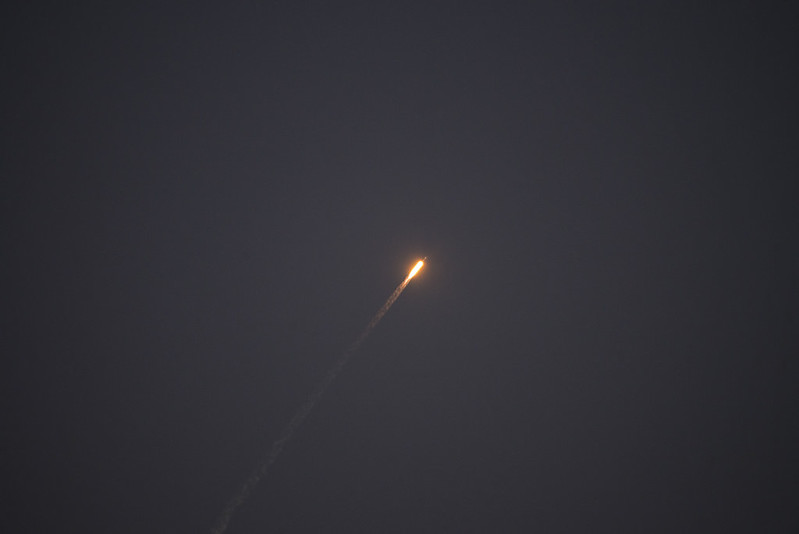
On Thursday 1 October at 18:10 Bulgarian time, Falcon 9 is due to send four people to the International Space Station from pad SLC-40 at Cape Canaveral. Crew-13 is the 13th regular crew rotation with Dragon and the capsule's 14th crewed flight to the station, counting the Demo-2 test mission. It sounds routine. NASA and SpaceX are certainly doing everything they can to make it look that way. But the road here has not been smooth.
The launch was originally planned for mid-September. While preparing the capsule, however, SpaceX found an oxidiser leak in Dragon's propulsion system, and the flight slipped by around two weeks while teams tracked down the cause and a fix. An oxidiser leak is not something you want to discover at the last minute, and frankly I would rather the agency lose two weeks in the hangar than take a chance in orbit. The flight readiness review ended with a unanimous "go". The rocket has been vertical on the pad since Sunday, and on Tuesday the crew went through a full dress rehearsal in their spacesuits, without fuelling.
The crew itself is quite a mix. NASA's Jessica Watkins is commander, her colleague Luke Delaney is pilot, and the mission specialists are Canada's Joshua Kutryk and Russian cosmonaut Sergey Teteryatnikov. For Watkins it is a second flight, making her the first NASA astronaut to launch twice on Dragon. For the other three it is a debut. A Russian, a Canadian and two Americans in one capsule belonging to a private company: geopolitics on the ground may do as it pleases, but on the ISS the rotation schedule is still being kept.
A bit of symbolism. The number 13 does not bring back the fondest memories in NASA's history, thanks to Apollo 13. The crew isn't pretending otherwise. They have even woven that story into the mission patch, with Delaney explaining that they are leaning on its legacy rather than on superstition. The coincidence with the propulsion leak is probably just that, a coincidence. Journalists are unlikely to let it pass, though.
The capsule also has a biography that concerns us directly. This is Grace, which in June 2025 flew Axiom Space's private Ax-4 mission, with Polish astronaut Sławosz Uznański-Wiśniewski and Hungary's Tibor Kapu on board. In other words, the same spacecraft that brought Central Europe back to space after a decades-long pause is now heading off on another routine shift.
The Falcon 9 first stage is flying for the third time, after Crew-12 and one Starlink mission. Forecasters at the Space Force's 45th Weather Squadron give a 60% chance of acceptable conditions, with cumulus clouds and precipitation along the flight path the main concerns. If all goes to plan, the crew will spend around six months on the station and splash down off the California coast in 2027. Until then, Crew-12 will hand over the experiments and station maintenance to them.