In 1974 Europe had satellites but nothing to launch them on. The Franco-German Symphonie satellites flew from Florida on an American rocket, under a condition that sounds almost insulting today: under the contract with NASA they could be used only for experimental and humanitarian purposes, not commercial ones. ArianeGroup calls the clause "draconian" and points to it as the real trigger for Ariane.
Five years later Europe was flying on its own. We made a five-minute video about this story; here are the details: how much each generation lifted, how often it flew, what went wrong and who paid. In short, each Ariane is better than the one before, and that is no accident.
A thread out of the labyrinth
On 31 July 1973, in Brussels, ministers from ten European countries approved the new rocket, according to ArianeGroup. France announced it would shoulder "a major part" of the funding. The working name was L3S, the "third-generation substitute launcher" (exactly as bureaucratic as it sounds). It was soon replaced by Ariane, the French form of Ariadne. She gave Theseus a thread to find his way out of the Minotaur's labyrinth, and Europe was looking for the same thing: a way out of dependence.
Ariane 1: modest, but it worked
On 24 December 1979 the first Ariane 1 lifted off from Kourou in French Guiana, according to ESA. The rocket could lift up to 1,850 kg to geostationary transfer orbit (GTO), from where communications satellites climb to their working slot on their own. On its first flight it carried the CAT-1 technology capsule, 1,645 kg and the heaviest payload Europe had launched until then. Modest by today's standards. In 1979 it was enough to start a business.
And Europe started one straight away. In 1980 came Arianespace, the world's first private launch services operator. The continent did not just build a rocket; it immediately set up a company to sell it.
Ariane 2 and 3: more thrust
The next steps were practical rather than revolutionary. Ariane 2 and 3 got more powerful engines, and Ariane 3 added two solid strap-on boosters. The first three versions flew 28 times between 1979 and 1989 and placed 38 satellites in orbit, and over those years Ariane claimed over half of the satellite launch market. A decade after asking for a ride, Europe was the market leader.
Ariane 4: the workhorse
Ariane 4 first flew on 15 June 1988. It was the first Ariane where Europe thought like a manufacturer, not just a designer. The rocket came in six versions, from no boosters to four, so each customer paid for exactly as much rocket as its satellite needed.
The result: 116 flights and 113 successes, a 97.4% reliability record and a run of 74 successful launches in a row, according to ESA. The most powerful version lifted about 4.8 tonnes to GTO, with a record of 4,946.9 kg. More than half of the satellites worldwide that Ariane could compete for flew on Ariane 4. Its most loyal customer was Intelsat, with 18 launches. The workhorse retired on 15 February 2003.
Ariane 5: the leap, and the fall before it
Ariane 5 was not another upgrade but a new rocket: a new hydrogen engine, Vulcain, two huge solid boosters and room for two large satellites at once. Its first flight, on 4 June 1996, ended in an explosion less than a minute after lift-off. ESA's inquiry board found specification and design errors in the software of the inertial reference system. The code had been inherited from Ariane 4 and nobody had checked it against the faster new rocket (a lesson still taught in software engineering courses).
Europe fixed the fault and carried on. Ariane 5 flew 117 times with 5 failures, and its longest streak was 84 successful flights in a row, according to CNES. On 2 June 2017 it set the record of 10,865 kg to GTO with two satellites at once, almost six times what Ariane 1 could lift.
Its payload list reads like a textbook of European spaceflight: the Rosetta probe to a comet, the five ATV cargo ships to the International Space Station, Galileo navigation satellites and, on 25 December 2021, the James Webb Space Telescope. (The second Christmas in this story, for anyone counting.) Ariane 5 flew for the last time on 5 July 2023.
The market changed
While Ariane 5 was piling up records, the rules of the game changed. SpaceX made its rocket reusable and launch became a volume business. The winner is whoever flies often and cheaply, not whoever lifts the most.
On 2 December 2014 ESA ministers decided to build Ariane 6. €4bn was earmarked for it, €400m of which from industry. The goal was a launch costing 40–50% less than Ariane 5. The first flight was promised for 2020 and came on 9 July 2024, four years late and a full year after the last Ariane 5. For those 12 months Europe had no heavy rocket of its own, an uncomfortable echo of 1974.
Ariane 6: one rocket, two versions
Ariane 6 was designed for a production line, not for craftsmanship. Ariane 62 has two boosters and lifts about 4.5 tonnes to GTO. Ariane 64 has four and lifts about 11.5 tonnes to GTO or 21.6 tonnes to low Earth orbit, according to ESA. It stands over 60 metres tall and weighs almost 900 tonnes at lift-off.
Three choices make the difference:
- The upper stage's Vinci engine can be reignited in space, so one rocket can deliver satellites to several different orbits.
- The P120C boosters are shared with the small Vega C rocket. They are built by Europropulsion, the joint venture of ArianeGroup and Italy's Avio. More identical parts means a cheaper unit.
- The core-stage engine, Vulcain 2.1, is an evolution of Ariane 5's Vulcain 2 rather than a clean-sheet design.
The prime contractor is ArianeGroup, the joint venture of Airbus and Safran, backed by several hundred companies in 13 European countries.
2026: the first Ariane 64 and a record
On 12 February 2026 the first Ariane 64 lifted off with 32 Amazon Leo satellites. It was Ariane 6's first commercial customer and Amazon's first launch on a European rocket. On 17 June flight VA269 flew with the new P160C boosters: up to 156 tonnes of propellant each and about 10% more payload to low Earth orbit. The rocket delivered 36 satellites, the heaviest payload in Ariane's history. That brought Amazon's tally to 100 satellites.
The customer seems happy. On 9 September Amazon ordered six more Ariane 64s, taking its contract with Arianespace to 24 launches instead of 18. Amazon said the expansion "reflects our confidence in Ariane 6".
The year has not been smooth. An anomaly in a liquid hydrogen turbopump, found during an engine test, pushed the schedule back: Ariane 6's tenth flight, with another 36 Amazon satellites, is set for no earlier than 23 November and will be only the fifth of 2026. The target for 2027 remains nine to ten launches, Arianespace confirmed to our colleagues at European Spaceflight.
Five generations, one direction
| Rocket | First flight | Flights (successful) | To GTO | Remembered for |
|---|---|---|---|---|
| Ariane 1–3 | 1979 | 28 | 1.85 t (Ariane 1) | Over half the market in the 1980s |
| Ariane 4 | 1988 | 116 (113) | ≈4.8 t | Six versions, 74 successes in a row |
| Ariane 5 | 1996 | 117 (112) | 10.9 t (record, 2017) | Rosetta, ATV, James Webb |
| Ariane 6 | 2024 | 9 (as of 10 Nov 2026) | ≈11.5 t (Ariane 64) | Vinci reignites in space |
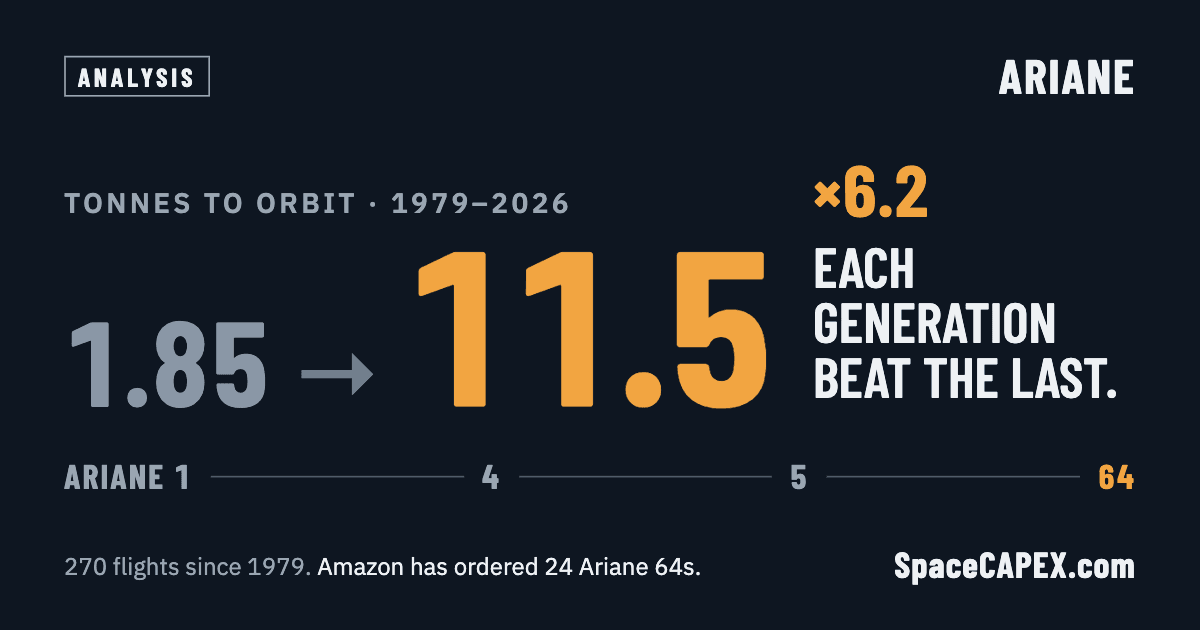
From 1.85 to 11.5 tonnes is 6.2 times the payload in 47 years. Ariane 64 lifts slightly more than Ariane 5's record, but it was designed to do it more cheaply. That is the sixth generation's improvement: not more tonnes, but a lower price per tonne.
Who pays
| What | Who pays | How much | Source |
|---|---|---|---|
| Developing Ariane (1973 decision) | European states, led by France | France takes "a major part" | ESA |
| Developing Ariane 6 (2014 decision) | ESA member states and industry | €4bn, of which €400m from industry | AFP via SpaceDaily |
| Operating Ariane 6, flights 16–42 (2026–2030) | ESA member states, in practice France, Germany and Italy | Up to €340m a year, in return for lower industry costs | CNES, European Spaceflight |
| 24 Ariane 64 launches | Amazon (Amazon Leo) | Price not disclosed | Satellite Today |
| Flight tests of the reusable Themis stage | European Commission, SALTO project | €42.8m budget | NewSpace Economy |
The model is almost as old as the rocket itself: governments pay for development and guarantee operations, and commercial customers fill the rocket. What is new is that 24 of Ariane 6's flights have now been ordered by an American company.
What comes next
Europe is already testing the technology that comes after Ariane 6. Prometheus is a methane and liquid oxygen engine designed for reuse. Themis is a demonstrator for a stage that lands again. ESA expects to decide by the end of November whether Themis's first low hop from the Esrange spaceport in northern Sweden can happen before winter, NewSpace Economy reports. If the next Ariane gets a name at all, it will most likely come back to Earth.
My take
This story undercuts the convenient cliché that Europe cannot build rockets. It can, and has done since 1979: each Ariane generation fixed the weakness of the one before. Ariane 4 brought flexibility, Ariane 5 brought power (after the painful lesson of 1996), and Ariane 6 brings a lower price and an engine that reignites in space.
The weak spot has always been something else: pace. Ariane 6 was four years late, Europe spent a year without a heavy rocket, and 2026 is ending with fewer flights than planned. So in 2027 I will be watching not the 11.5 tonnes but the promised nine to ten flights. If Arianespace delivers them, the story in the video gets its next chapter. If not, 11.5 tonnes will remain a fine record for a rocket that flies too rarely.
But let's keep some perspective. Europe started by asking for a ride under a "no commercial use" condition and has ended up with 24 launches ordered by Amazon. For 47 years, that is a very good journey.