The question is simple: can Europe supply on its own the satellites it relies on for internet access, navigation, Earth observation and defence? The answer is less so. Europe can build them, can only sometimes launch them, and buys less European than it likes to think. Here are the numbers as of late October 2026, link by link.
Seven times over
According to the KeepTrack catalogue, there were 11,131 Starlink satellites in orbit in October. All European satellites combined (those of EU countries, the UK, Norway, Switzerland, ESA, EUMETSAT and Eutelsat) number 1,576, and that includes dead ones. Of those, 1,301 are active. A single American company has seven times more satellites in orbit than an entire continent.
Close to 40% of Europe's satellites belong to just one operator: Eutelsat's OneWeb, with 654 spacecraft that the catalogue files under the UK. Without the UK, Europe has 795 satellites in orbit, 565 of them active.
Who builds them
The big three manufacturers are Airbus Defence and Space, Thales Alenia Space (a joint company of Thales and Leonardo) and Germany's OHB. The first two are currently trying to become one. In October 2025 Airbus, Thales and Leonardo agreed to merge their space businesses under Project Bromo. The new company would have about €6.5bn in revenue and some 25,000 staff, according to Grosswald. A European Commission decision is not expected before the second half of 2027. OHB opposes the merger. In June 2026 it raised about €900m on the stock market.
OHB is no minnow. According to the company, its 2025 revenue was €1.248bn, order intake hit a record €2.078bn and its order backlog stood at €3.194bn. Thales's space business ended 2025 with a €10.8bn backlog, Space Intel Report reports.
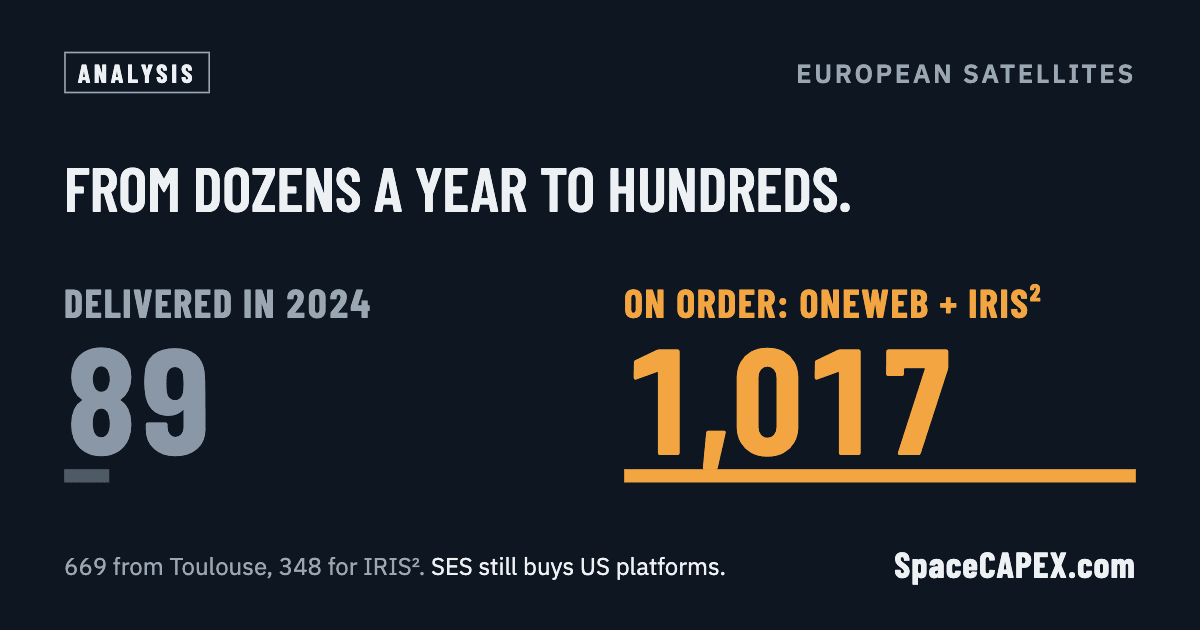
The industry as a whole is bigger than it looks from outside. Industry association Eurospace puts European manufacturers' 2024 sales at €8.835bn, with 66,061 employees and 89 spacecraft delivered to the launch pad: 50 large and 39 small. In 2025 sales jumped 23% to about €10.9bn, with 68,139 employees, according to Space Intel Report.
The new wave moves faster than the old. Finland's ICEYE, which builds radar satellites, reported more than €250m in revenue and over €100m in EBITDA for 2025, according to ArcticToday. In June it raised €450m at a valuation above €10bn and pledged to double output from 50 to 100 satellites a year by 2028, SpaceQ reports. Belgium's Aerospacelab is building a factory in Charleroi for up to 500 satellites a year, according to the company. Bulgaria's EnduroSat already has more than 100 satellites in orbit and over 450 customers, with 2025 revenue of €34–35m, Capital writes. In September it raised $205m, Dealroom reports.
| Manufacturer | Country | What it builds | Key number |
|---|---|---|---|
| Airbus Defence and Space | France, Germany, Spain, UK | Telecoms, OneWeb, Galileo, military | 669 new OneWeb satellites on order |
| Thales Alenia Space | France, Italy | Telecoms, Galileo, IRIS² payloads | Thales space backlog: €10.8bn |
| OHB | Germany | Galileo, science missions, small GEO | 2025 revenue: €1.248bn |
| ICEYE | Finland | Radar satellites | 50 satellites a year, 100 by 2028 |
| Aerospacelab | Belgium | Low Earth orbit platforms | Factory for up to 500 satellites a year |
| EnduroSat | Bulgaria | Nanosatellites and spacecraft up to 500 kg | More than 100 satellites in orbit |
Who buys them
This is the first problem. Europe's space industry lives on public money. In 2024, 72% of its sales went to European public customers and only 10% to European private companies, Eurospace data show. ESA alone accounts for more than a third of industry revenue. Demand for commercial geostationary satellites, for years the bread and butter of Airbus and Thales, has halved since its 2017 peak. Eurospace links the slump to competition from Starlink.
Reliance on the state has an upside, because Galileo, Copernicus and IRIS² provide steady orders. The downside is that governments order satellites by the dozen, while Starlink orders them by the thousand.
Who runs them
Europe is home to two of the world's largest satellite operators. Luxembourg's SES bought Intelsat and now runs about 120 satellites, around 90 in geostationary orbit and about 30 in medium orbit, TeleSemana reports. Its 2025 revenue was €2.627bn (€3.512bn counting Intelsat for the full year), according to SES. France's Eutelsat owns OneWeb, Europe's only megaconstellation. Its revenue for the 2025-26 financial year was €1.23bn, while low Earth orbit revenue jumped 69.5% to €297m and now makes up a quarter of the total, Advanced Television reports.
Eutelsat also shows how state-backed European connectivity is. After a €1.5bn capital increase in 2025, the French state holds 29.65%, India's Bharti 17.88% and the UK 10.89%, according to Eutelsat.
European operators buy European satellites only some of the time.
- Eutelsat buys European. In September it ordered another 229 OneWeb satellites from Airbus in Toulouse, bringing the new-generation order to 669 satellites, more than OneWeb's entire current fleet, Raksha Anirveda reports. The first generation was assembled in Florida.
- SES partly buys American. Its new medium-orbit network, meoSphere, will be built on 28 platforms from US-based K2 Space, with SES making the payloads in Luxembourg, TelecomTV reports. After buying Intelsat, SES also halted production of two geostationary satellites ordered from Thales Alenia Space.
- Spain's Hispasat is now part of Indra and will build the IRIS² ground segment for more than €1.6bn.
| Operator | Headquarters | Fleet | Revenue | New satellites from |
|---|---|---|---|---|
| SES (with Intelsat) | Luxembourg | About 120 satellites | €2.627bn (2025) | K2 Space (US) for meoSphere, Airbus for two GEO |
| Eutelsat (with OneWeb) | France | 654 OneWeb satellites plus GEO | €1.23bn (2025-26) | Airbus, Toulouse: 669 satellites |
| Hispasat (Indra) | Spain | Geostationary | Not stated | IRIS² ground segment |
IRIS²: Europe's big order
IRIS² is the EU's answer to Starlink, and it is growing. In December 2024 the project was for 290 satellites and €10.6bn, European Spaceflight reported. On 7 August 2026 the European Commission expanded it to 348 satellites: 330 in low orbit and 18 in medium orbit. On top of those comes an additional 66-satellite defence layer in low orbit, according to EUSPA. Public funding is €11.6bn, with the three private operators adding up to €4bn, Advanced Television reports. The first launches are planned for 2029.
The biggest surprise is who will build it. Belgium's Aerospacelab wins 264 of the 330 low-orbit satellites, Airbus the remaining 66, and Thales Alenia Space will supply payloads for all 330, according to Tech Funding News. It puts the Aerospacelab contract at €2.4bn, while Handelsblatt, cited by EU Insider, puts it at about €1.8bn. SES takes the 18 medium-orbit satellites, to be assembled in Luxembourg, with an investment of up to €1.35bn, SatNews reports.
| IRIS² layer | Number | Who builds or runs it |
|---|---|---|
| Low orbit | 330 | Aerospacelab (264), Airbus (66); payloads from Thales Alenia Space |
| Medium orbit | 18 | SES, Luxembourg |
| Defence layer in low orbit | 66 | Not announced |
| Ground segment | Not applicable | Hispasat (Indra) |
| Launches | Not announced | No provider chosen |
The last row is not a mistake. The Commission itself lists securing launch services as a next step.
Launch: the weakest link
In 2025 the US carried out 193 orbital launches, China 93 and Europe 7, according to SpaceStats data cited by The Parliament Magazine. Researchers at the Belfer Center point out that between July 2023 and July 2024 Europe had no working rocket at all.
The picture in 2026 is better, but not by much. By the end of October Ariane 6 had flown four times, and its next flight for Amazon will be its fifth of the year, according to Arianespace. Vega C launched SMILE in May and Sentinel-3C with FLEX in September, Spaceflight Now reports. Germany's Isar Aerospace reached orbit on 5 September from Norway, the first rocket to do so from Western European soil, Space.com reports. That makes seven launches in ten months. Over the first nine months of the year SpaceX carried out 113, according to the company.
That is why European satellites fly on American rockets. The European Commission signed a €180m deal with SpaceX to launch Galileo satellites, and Austria's first military satellite will fly with SpaceX in 2027, The Parliament Magazine reports. According to the Bruegel think tank, cited there, Ariane can cost up to three times as much. The irony is complete given that Ariane 6's biggest customer is Amazon, the American company building a Starlink rival.
Components: the quiet dependency
Even when a satellite is assembled in Toulouse or Bremen, part of it comes from elsewhere. The latest public estimate I could find is from French space agency CNES, from about a decade ago: more than a third of the value of critical components in European satellites comes from outside Europe, mainly from the US, SpaceNews reported. Some of them fall under US arms export rules (ITAR). That there is no more recent public figure also says something.
The money
The funding gap is smaller than the launch gap, but still wide. In 2025 government space spending in the US was $77.1bn, against $14.6bn across Europe, more than five times less, the Belfer Center calculates. Venture capital was about €8bn in the US against €1.4bn in Europe. This year's big European rounds (€450m for ICEYE, $205m for EnduroSat) are serious money for Europe, but in the US SpaceX alone raised $75bn on the stock market in June.
Who pays
Public money
| Who pays | To whom | For what | How much | Source |
|---|---|---|---|---|
| EU and ESA | SpaceRISE consortium (Eutelsat, SES, Hispasat) | IRIS²: 348 satellites and ground segment | €11.6bn | Advanced Television |
| IRIS² (SpaceRISE) | Aerospacelab | 264 low-orbit satellites | €1.8–2.4bn (figures differ) | Tech Funding News, EU Insider |
| IRIS² (SpaceRISE) | Thales Alenia Space | Payloads for 330 low-orbit satellites | About €500m | Tech Funding News |
| French state | Eutelsat | Capital increase, 2025 | €551m (29.65% stake) | Eutelsat |
| United Kingdom | Eutelsat | Capital increase, 2025 | €163.3m (10.89% stake) | Eutelsat |
| European Commission | SpaceX | Launch of Galileo satellites | €180m | The Parliament Magazine |
Private money
| Who pays | To whom | For what | How much | Source |
|---|---|---|---|---|
| SES | Own investment | IRIS² medium-orbit layer (18 satellites) | Up to €1.35bn | SatNews |
| Hispasat (Indra) | Own investment | Access to IRIS²'s low layer | Up to €600m | Advanced Television |
| Eutelsat | Airbus | 229 new OneWeb satellites (669 in total) | Not disclosed | Raksha Anirveda |
| SES | K2 Space (US) | 28 platforms for meoSphere | Not disclosed | TelecomTV |
| Investors (led by General Atlantic) | ICEYE | Series F round | €450m | SpaceQ |
| Investors (led by Riot Ventures and Atreides) | EnduroSat | Round for serial production | $205m | Dealroom |
| Stock market investors | OHB | Share placement, June 2026 | About €900m | Grosswald |
Self-sufficiency, link by link
The scores are SpaceCAPEX's own, on a scale of 1 to 5. The numbers beside them come from the sources above.
| Link | Score | The number that decides it |
|---|---|---|
| Satellite manufacturing | 4/5 | 89 spacecraft delivered in 2024; 669 OneWeb satellites from Toulouse; 264 IRIS² satellites from Charleroi |
| Operators | 3/5 | SES with about 120 satellites and Eutelsat with 654 in low orbit, but meoSphere's platforms are American |
| Components | 2/5 | More than a third of the value of critical components comes from outside Europe (CNES) |
| Megaconstellations | 2/5 | 1,576 European satellites in orbit against 11,131 Starlinks; IRIS² from 2029 |
| Money | 2/5 | Government spending more than 5 times and venture capital about 6 times lower than in the US |
| Launch | 1/5 | 7 launches in 2025 against 193 for the US |
Our view
If the question is whether Europe can build its own satellites, the answer is yes, and with growing confidence. For the first time, European factories will turn out satellites by the hundred rather than by the dozen: 669 for OneWeb in Toulouse and 264 for IRIS² in Charleroi. That a Belgian start-up took three quarters of Europe's biggest order ahead of Airbus convinces me more than any merger that competition works. Which is why I am sceptical of Bromo: a bigger champion does not make satellites cheaper, and with less competition it could make them dearer.
If the question is whether Europe can launch them on its own, the answer is not yet. Seven launches a year is not enough for a continent that wants its own megaconstellation from 2029. Unless Ariane 6 reaches ten or so flights a year and the start-ups begin flying regularly, IRIS² stands a real chance of flying partly on Falcon 9. That would be great publicity for SpaceX and awkward for European sovereignty.
There is a Bulgarian footnote too. Bulgaria's only geostationary satellite, BulgariaSat-1, was built in the US and launched on a Falcon 9. Today EnduroSat has more than 100 satellites in orbit and is building a plant near Sofia, while Bulgaria is not yet even an associate member of ESA. The industry is ahead of the state.