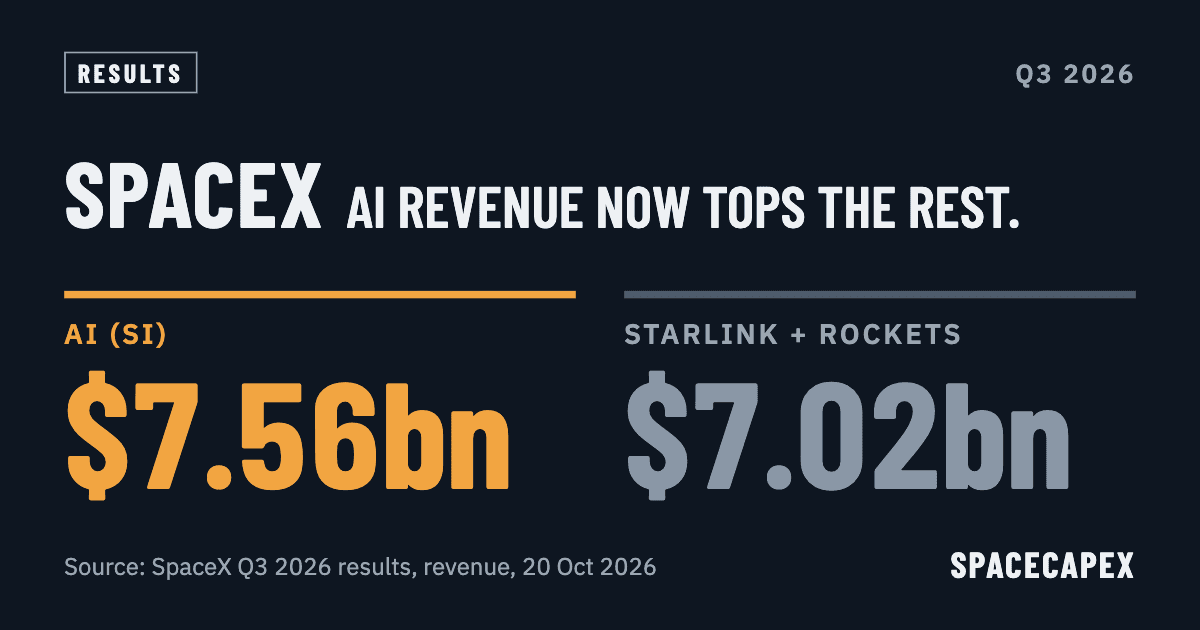
A rocket company where rockets bring in 12% of revenue. That is what SpaceX looks like after the third quarter of 2026. According to the company, revenue was $14.575bn. That is up 161% on a year earlier and 87% on the second quarter. Artificial intelligence brought in $7.56bn. Until last quarter the segment was called AI; now it is called Super Intelligence (SI). That is more than Starlink and rockets combined, which together bring in $7.015bn.
The market liked the numbers. Yahoo Finance writes that, according to Bloomberg, analysts had expected around $12.7bn in revenue and $6.59bn in adjusted EBITDA. SPCX closed at $147.79 on 20 October and rose 6.6% in after-hours trading following the results, Investing.com reports. The company has 13.58bn class A and B shares (per the report, as of 30 September), so at the closing price its market capitalisation is around $2.0tn. At the June IPO the stock was priced at $135.
| Metric (Q3 2026) | Reported | Expected (Bloomberg) | Difference |
|---|---|---|---|
| Revenue | $14.58bn | ~$12.7bn | +15% |
| Adjusted EBITDA | $8.81bn | $6.59bn | +34% |
The numbers by segment
| Segment | Revenue, $m | Year-on-year growth | Operating income, $m | Adjusted EBITDA, $m | Capital expenditure, $m |
|---|---|---|---|---|---|
| Starlink (Connectivity) | 5,248 | +69% | 2,367 | 3,499 | 1,543 |
| Artificial intelligence (SI) | 7,560 | +830% | 431 | 4,953 | 16,444 |
| Rockets (Space) | 1,767 | +6% | −7 | 357 | 1,606 |
| Total | 14,575 | +161% | 2,791 | 8,809 | 19,593 |
Net income of $4.404bn is larger than operating income. The difference comes from $873m in interest income (the IPO money is sitting in the bank and in securities), a further $1.025bn in other income and a $390m tax credit. Against that stand $675m in interest expense. A year earlier the company made a loss of $1.05bn.
Rockets: breaking even, and on purpose
The Space segment brought in $1.767bn in revenue, 6% more than a year earlier. Its operating result, however, was a $7m loss, against a $259m profit a year before. According to the company, segment costs rose by $367m because it is accelerating Starship development. R&D spending in Space alone was $1.225bn, up 44% year on year. Falcon 9 is not in trouble. It is paying for its successor.
There were fewer launches: 35 against 44 a year earlier. Only 12 were for customers. Revenue from customer launches nevertheless rose from $1.0bn to $1.13bn, so fewer flights brought in more money. In total, 476 tonnes went to orbit, three-quarters of it SpaceX's own payloads.
The big event was Starship Flight 14, the rocket's first orbital flight. It carried 26 Starlink V3 satellites which, according to the company, provide around ten times the downlink capacity of a Starlink batch on Falcon 9. The company also reported the first revenue-generating Starship mission. On the analyst call, Elon Musk said Flight 15 would come next month and would attempt to catch both the booster and the ship with the tower. He put the chance of success at "more likely than not", MarketBeat reports. The goal is weekly flights in the first half of 2027.
During the quarter SpaceX signed three more crewed ISS missions for NASA, 18 missions under the Pentagon's National Security Space Launch programme and a contract to deliver cargo to the Moon with Starship. The company also announced a new Starbase in Louisiana, with a first launch expected in 2029.
Starlink: the money machine
If I had to pick one line in the report that explains the $2tn valuation, it would be Starlink's operating income. It was $2.367bn, almost double a year earlier, on revenue of $5.248bn. The operating margin was 45%, up from 38% three months ago. There is an asterisk: on the analyst call the CFO said the 55% gross margin includes around 3 points of one-off benefit from tariff refunds (MarketBeat).
| Starlink | Q3 2026 | Q2 2026 | Q3 2025 |
|---|---|---|---|
| Subscribers (households), m | 13.6 | 12.0 | 7.2 |
| Average revenue per subscriber, $ a month | 69 | 66 | 83 |
| Subscriber revenue, $m | 3,121 | 2,485 | 1,986 |
| Enterprise and government revenue, $m | 2,127 | 1,806 | 1,111 |
In the quarter alone Starlink added 1.6m subscribers. Average revenue per subscriber is $14 lower than a year earlier, so growth is coming from volume rather than price. The service is now on board more than 3,800 aircraft. On the call the company mentioned 174 markets and more than 22m monthly Starlink Mobile users, counted separately from subscribers. On 8 October SpaceX signed a spectrum deal in the 800 MHz band, due to close in the first half of 2027.
A small detail from the footnotes: SpaceX now counts satellites that have been cleared for deorbit as "satellites in orbit". Under the old definition the figure would be around 400 lower. The company says the change does not affect financial results. Around 400 satellites is roughly the entire Amazon Leo constellation, so SpaceX added a whole competitor to its tally just by changing a definition.
Super Intelligence: 830% and one big purchase
SI revenue was $7.56bn. A year earlier it was $813m, and in the second quarter $2.56bn. The company attributes the jump to cloud services contracts, the acquisition of Cursor and wider use of Grok. Cursor was bought on 14 August at an equity valuation of $60bn and had brought in $608m of revenue by the end of September. Without it, SI still tripled its revenue in a single quarter.
The segment's operating income was $431m. That includes $1.2bn of stock-based compensation linked to Cursor. In the report the company calls the quarter a "clear inflection" in the Super Intelligence business. Compute capacity reached 1.7 GW, against 0.6 GW a year earlier. Musk expects 2.5–3 GW by the end of the year and at least another 10 GW in 2027.
This is where I turn sceptical. The "solutions and infrastructure" line, worth $7.02bn, is not defined in the report, and the cloud contract customers are not named. Musk says he prefers short-term compute contracts because he expects the price per watt to rise. The logic is reasonable, but short-term revenue is also less certain revenue.
Who pays SpaceX
| Who pays | To whom | For what | How much (Q3 2026) | Source |
|---|---|---|---|---|
| SI customers (cloud services, Grok, Cursor) | SpaceX, SI segment | AI solutions and infrastructure | $7.022bn | SpaceX, Q3 2026 |
| 13.6m Starlink subscribers | SpaceX, Connectivity segment | Household internet | $3.121bn | SpaceX, Q3 2026 |
| Enterprise and government (aviation, maritime, governments) | SpaceX, Connectivity segment | Starlink for corporate and government customers | $2.127bn | SpaceX, Q3 2026 |
| Launch customers (NASA, the Pentagon, commercial operators) | SpaceX, Space segment | Launches | $1.130bn | SpaceX, Q3 2026 |
| Space customers | SpaceX, Space segment | Launches and development | $637m | SpaceX, Q3 2026 |
| Advertisers | SpaceX, SI segment | Advertising | $538m | SpaceX, Q3 2026 |
| IPO investors | SpaceX | Shares at the stock market debut (June 2026) | $85.675bn net over 9 months | SpaceX, Q3 2026 |
The first six rows add up to $14.575bn, the quarter's revenue. The last row is not revenue, but without it the next section would not be possible.
The bill: capital expenditure
In the third quarter SpaceX spent $19.6bn on capital investment, 84% of it on artificial intelligence. Over nine months the total is $48.1bn. For the fourth quarter the company forecasts $35–40bn, so the year will end at $83–88bn. Operating cash flow for nine months was $13.1bn, which means free cash flow of around −$35bn. The company has $89.9bn in cash and securities and $38.8bn of debt. In other words, the net $85.7bn from the IPO covers roughly one year at this pace. Even before the results, Morgan Stanley's Adam Jonas called the need for fresh funding a key weight on sentiment around the stock, Yahoo Finance writes.
The guidance
| What | Target | Source |
|---|---|---|
| Capital expenditure, Q4 2026 | $35–40bn | Analyst call (Investing.com, MarketBeat) |
| Annualised revenue run rate by December 2026 | $100bn | Analyst call |
| Revenue, Q1 2027 | $33–37bn | Analyst call |
| Compute capacity at end-2026 | 2.5–3 GW | Musk, analyst call |
| Weekly Starship flights | First half of 2027 | Musk, analyst call |
| First launch from Louisiana | 2029 (internal target 2028) | SpaceX, Q3 2026, MarketBeat |
Guidance for the first quarter of 2027 is $33–37bn, more than double the $14.6bn just reported. If SpaceX hits it, it will be a quarter few companies in the world can match. If it misses, it will become clear how much of the current valuation rests on it.
There was also a question about Tesla. Musk confirmed that the two companies have set up independent committees to discuss a possible merger, but there are no terms and a deal is not guaranteed. According to Investing.com, he nevertheless called a combination a "good idea".
What I think
SpaceX is now three companies under one roof, and the space one is the smallest. Starlink is the money machine: a 45% operating margin and subscribers growing by 1.6m a quarter. Rockets are breaking even because every dollar of profit goes into Starship, and I think that is right, because without Starship there is no V3, no Mobile V2 and no cheaper access to orbit. SI is a bet bigger than everything else in the company. The report shows the bet is starting to generate revenue. It doesn't show how durable that revenue is, or who the customers are.
So at the next report I will be watching two lines: whether SI revenue grows without new acquisitions like Cursor, and how much of the IPO money is left after the fourth quarter. Starship Flight 15 next month will say more about the space side of SpaceX than this entire report.
This article is for information purposes only and is not investment advice.