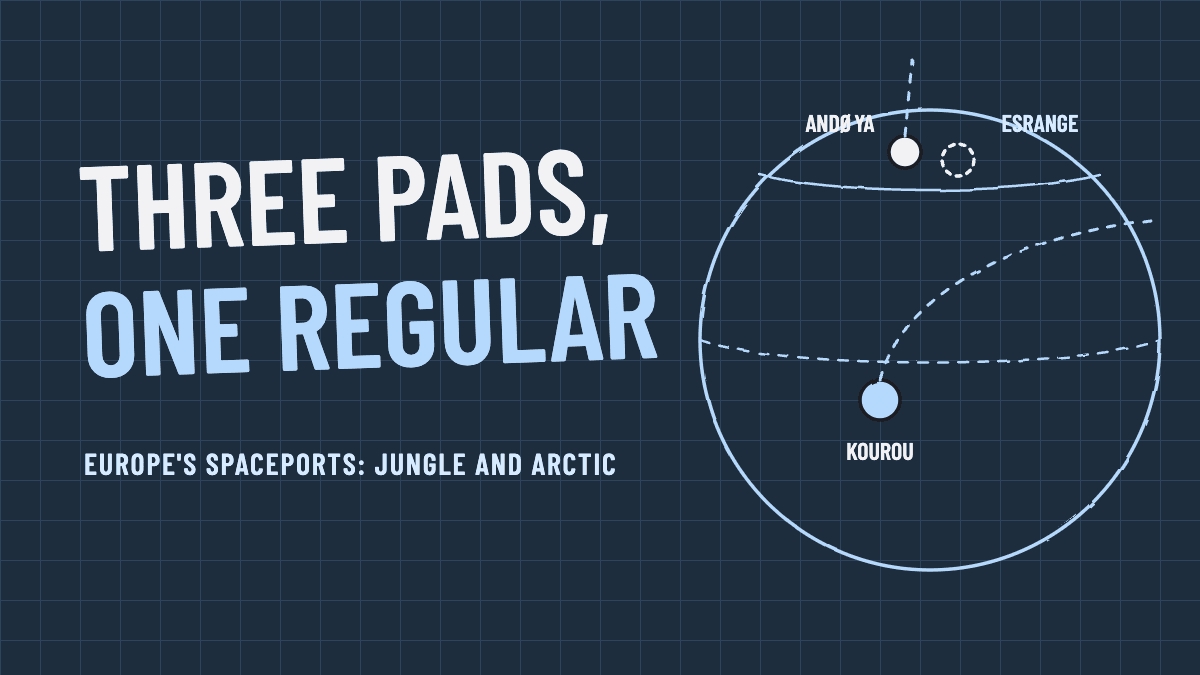
If we're being precise, we have to start with a caveat. The European Union has exactly one spaceport from which rockets regularly fly to orbit, and it isn't in Europe. It lies in South America, five degrees north of the equator, in French Guiana, which is legally as much a part of the EU as Burgas. The other two in this article are in the Arctic. Sweden's Esrange is inside the Union but has yet to launch anything into orbit. Norway's Andøya already has, but Norway is not an EU member, only a member of ESA and the European Economic Area. I include it deliberately, because customers care whether rockets fly from a pad, not what passport it holds.
Why it matters where the pad is
The Earth spins, and it gives a free boost to every rocket heading east. At the equator that gift is around 1,670 km/h, faster than an airliner. The further north you go, the smaller it gets. For a satellite that has to sit 36,000 km above the equator, the difference between launching from French Guiana and launching from Norway is measured in tonnes of propellant.
For polar and sun-synchronous orbits the picture flips. There the rocket flies north or south, and ideally has nothing but cold sea and tundra beneath its path. That is why Europe has pads at both ends of the map. They don't compete; they serve different customers.
Kourou: the spaceport born from the loss of Algeria
France launched its first rockets from the Algerian desert. When Algeria became independent in 1962, the young French space agency CNES (founded only months earlier, in December 1961) was left without a launch site. According to ESA, the French studied 14 locations, and in April 1964 prime minister Georges Pompidou announced the choice: French Guiana. Construction began in 1966. On 9 April 1968 a small Véronique rocket officially opened the centre, and in 1970 the first orbital mission lifted off from there: a French Diamant-B carrying a Franco-German satellite. Meanwhile the European organisation ELDO moved its Europa II there from Woomera in Australia.
The real story begins on Christmas Eve 1979, when the first Ariane lifted off. Four more generations followed. Ariane 5 flew 117 times between 1996 and 2023, and on Christmas Day 2021 sent the James Webb telescope on its way. From 2011 Kourou also had a pad for Russia's Soyuz. It fell silent in February 2022, when the Russians left after the invasion of Ukraine.
Today. Ariane 6 has been flying since July 2024 and has nine flights to its name, four of them in 2026, according to the list of Ariane launches. Three were for the Amazon Leo satellite network, and one, in August, put EUMETSAT's MTG-I2 weather satellite into orbit. Arianespace is aiming for up to eight flights this year. Italy's Vega C also flies from Kourou, now with Avio as operator. And here lies the paradox of European space sovereignty: the busiest customer of Europe's heavy rocket is an American company building a rival to Starlink.
Tomorrow. CNES is opening up the jungle to small rockets. The former Soyuz pad, renamed ELM2, has gone to MaiaSpace, ArianeGroup's subsidiary. The old Diamant pad is being turned into a multi-operator complex. Our colleagues at European Spaceflight followed the selection. In July 2025 seven companies made the shortlist: HyImpulse, Isar Aerospace, PLD Space, RFA, Latitude, MaiaSpace and Avio. Avio and HyImpulse later dropped out without explanation, and in April 2026 MaiaSpace's slot went to France's Sirius Space Services, which is planning its first flight for the end of 2028. Spain's PLD Space is investing €35m in its own infrastructure and aiming for a MIURA 5 debut by the end of this year. If it all comes off, Kourou will look less like a state facility and more like a co-operative.
Andøya: an island of fishermen, rockets and one nervous Yeltsin
The Norwegians started early. Andøya launched its first rocket, Ferdinand 1, on 18 August 1962, just five years after Sputnik. It climbed to around 102 km to study the ionosphere. For decades the island was a base for sounding rockets diving into the northern lights.
In 1995 one of those rockets nearly became world news. Russian radars mistook a Black Brant research rocket for a submarine-launched nuclear missile. The advance notice from Oslo had got lost somewhere in the bureaucracy, and Boris Yeltsin was alerted before the military worked out that the rocket was not heading for Russia. To this day the story is a favourite example of how thin the line between science and panic can be.
Ownership is simple: 90% belongs to Norway's ministry of trade and industry and 10% to Kongsberg Defence. The small-satellite spaceport project began in 2018, with the state providing NOK 365.6m. Isar Aerospace secured exclusive access to one pad for up to 20 years. Crown Prince Haakon officially opened the spaceport in November 2023.
Today. Spectrum's first flight on 30 March 2025 ended around 30 seconds after lift-off. On 25 March 2026 the countdown was stopped three seconds before launch because a fishing boat entered the safety zone. Its skipper had previously disrupted a German air force bombing exercise; clearly a man of principle. On 5 September Spectrum reached orbit with five CubeSats and one experiment, among them Platform 6 from Sofia-based EnduroSat. It was the first successful orbital launch of a private European rocket. Alongside the spaceport, the island also hosts the Andøya Test Center missile range, so the military are regular visitors too.
Tomorrow. Andøya's future rests almost entirely on one customer. According to Isar, rockets three to seven are already in production, and the new factory is meant eventually to produce up to 40 rockets a year. But Isar is also building a second pad, in Nova Scotia (Canada), for higher-inclination orbits. A spaceport with one customer is like a hotel with one regular guest: it works perfectly until the guest decides to sleep elsewhere.
Esrange: 600 rockets and none in orbit (yet)
Esrange sits around 200 km north of the Arctic Circle, next to the Swedish mining town of Kiruna. Construction began in 1964 under ESRO, ESA's predecessor, and the first rocket, Centaur-1, flew on 19 November 1966. In 1972 the base passed entirely to the state-owned Swedish Space Corporation (SSC). Since then more than 600 sounding rockets have flown from there (the 600th on 11 November 2024), along with around 700 stratospheric balloons. The base covers 20 km², but the zone where spent stages fall is 5,600 km², slightly smaller than Bulgaria's Plovdiv Province. Esrange is also the hub of the world's second-largest civilian network of satellite ground stations.
Today. On 13 January 2023 King Carl XVI Gustaf, prime minister Ulf Kristersson and Ursula von der Leyen opened the new LC-3 orbital complex. It was billed as the first orbital spaceport in continental EU. Three and a half years later nothing has yet flown to orbit from there. In 2024 SSC signed with US-based Firefly Aerospace for flights of its Alpha rocket, targeting 2026. Payload, as cited by Ground News, reports that the target is now 2028. The reason is years of negotiation between the US and Sweden, which produced a technology safeguards agreement only in June 2025. The LC-3C pad is under construction. South Korea's Perigee also has an agreement for its Blue Whale 1 rocket.
In the meantime Esrange does useful, if less glamorous, work as a test range. Isar and RFA test engines and stages there, and ArianeGroup brought the Themis reusable stage prototype for its first "hops", planned for 2026.
The irony is hard to miss. The only spaceport in continental EU with orbital ambitions is waiting for an American and a Korean rocket, while Europe's small rockets chose Norway, Scotland and Guiana.
The substitutes' bench
There are other contenders, but for now they are more plans than launches. Britain's SaxaVord in Shetland is home to RFA but has launched nothing, orbital or suborbital. Germany's HyImpulse is preparing a suborbital flight from there this month. The UK isn't in the EU either. Portugal has talked for years about a site on Santa Maria in the Azores, and Germany is discussing a floating platform in the North Sea.
The three spaceports at a glance
| Kourou | Andøya | Esrange | |
|---|---|---|---|
| Country | France (French Guiana) | Norway | Sweden |
| In the EU? | Yes | No (EEA and ESA) | Yes |
| Latitude | ~5° N | ~69° N | ~68° N |
| First rocket | 1968 | 1962 | 1966 |
| First orbital mission | 1970 (Diamant-B) | 2026 (Spectrum) | None yet |
| Operator | CNES, for ESA | Andøya Space (90% state-owned) | SSC (state-owned) |
| Rockets today | Ariane 6, Vega C | Spectrum (Isar) | Sounding rockets, testing |
| Next step | MIURA 5 (end-2026), Sirius (2028) | Regular Spectrum flights | Firefly Alpha (2028) |
| Best suited for | Geostationary orbit, heavy payloads | Polar and sun-synchronous orbit | Polar and sun-synchronous orbit |
What I think
Europe has more pads than rockets to fly from them. Concrete is the easy part: Norway built an entire spaceport with public money that would cover a few kilometres of motorway. The hard part is a rocket that flies every month without anyone writing an article about it. Kourou has one, and has done since 1979. The Arctic is only just starting to try. The next two years will show three things. Whether Isar can turn one successful flight into a timetable. Whether MIURA 5 lifts off from the jungle by the end of the year. And whether the first orbital rocket from continental EU will be European at all.