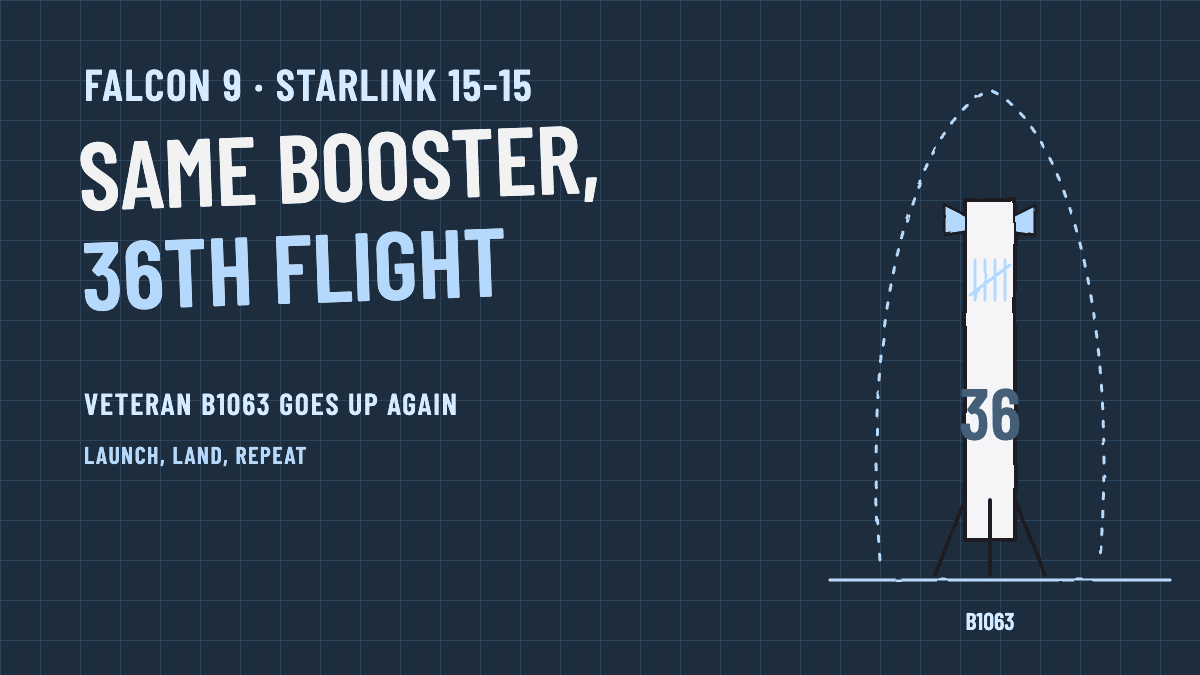
Falcon 9 is due to lift off on Tuesday 20 October at 22:14 UTC from pad SLC-4E at Vandenberg, California. In Bulgaria that will be 01:14 in the early hours of Wednesday. Spaceflight Now reports that there are 27 Starlink V2 Mini Optimized satellites on board, and the first stage will attempt to land on the droneship Of Course I Still Love You in the Pacific.
The satellites themselves aren't the news; the booster is. Spaceflight Now lists B1063 for its 36th flight. This stage launched the Sentinel-6 Michael Freilich ocean-monitoring satellite and NASA's DART mission, which in 2022 slammed into the asteroid Dimorphos and changed its orbit. B1063 later carried NROL spy satellites, SDA military satellites and 25 batches of Starlinks. A rocket that tested planetary defence against an asteroid now delivers internet routers. Space.com noted that on its 35th flight on 2 September, B1063 was two flights short of B1067's record. After this launch it will be one.
Four days later, Starlink 15-16 is due to fly from the same pad. The pace is such that Starlink missions now differ mainly by their number. According to Space.com, by 2 September SpaceX had flown 102 Falcon 9 missions in 2026, 79 of them for Starlink.
Who pays
Starlink is an internal mission: there is no outside customer and no contract price. Since its stock market debut in June (Nasdaq, ticker SPCX, $135 a share), SpaceX has been reporting publicly how this arithmetic works. According to the company, it carried out 38 launches in the second quarter. Of those, 28 were internal and charged mainly to the Connectivity segment, in other words to Starlink.
| Who pays | To whom | For what | How much | Source |
|---|---|---|---|---|
| SpaceX (charged to the Connectivity segment) | Own rocket, no outside customer | The Starlink 15-15 launch | Not disclosed per flight | SpaceX, Q2 2026 |
| Starlink customers (including 12m subscribers) | SpaceX | Internet service, Q2 2026 | $4.291bn in segment revenue | SpaceX, Q2 2026 |
| SpaceX | Own investment | Connectivity capital expenditure, Q2 2026 | $1.367bn | SpaceX, Q2 2026 |
What I think
Starlink 15-15 is a boring flight, and the boredom is precisely the news. According to SpaceX's report, the Space segment ended the quarter with a $542m operating loss, while Connectivity earned $1.656bn. A company that can afford 28 launches of its own in three months, because 12 million people pay it an average of $66 a month, is now an internet company with rockets, not a rocket company with internet. For Amazon Leo, waiting on Ariane 6 and Vulcan, that is the most uncomfortable comparison of all.
For those who follow the numbers: SLC-4E, low Earth orbit, landing in the Pacific. B1063 will fly 48 days after its previous mission, and the launch window opens at 15:14 local time.
This article is for information purposes only and is not investment advice.