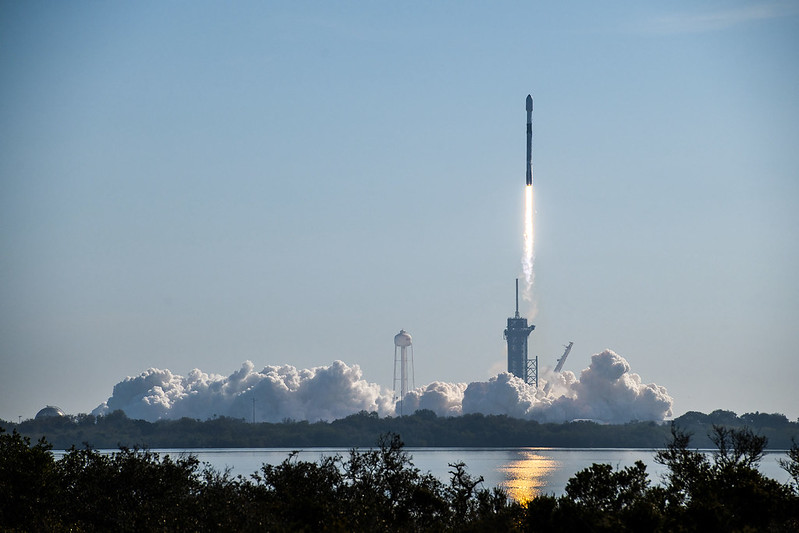
On Saturday evening California time, or 2:00am on Sunday in Bulgaria (23:00 UTC on 10 October), Falcon 9 is due to lift off from pad SLC-4E at Vandenberg with 27 Starlink V2 Mini Optimized. satellites. The mission is Starlink Group 15-25. It was originally scheduled for 30 September but slipped by ten days. For SpaceX that is an almost trivial detail: in the meantime the company has launched a crew to the space station, a spy satellite on Falcon Heavy, 130 payloads on Transporter-18 and 21 military satellites for the SDA.
I'll admit Starlink launches stopped making headlines a long time ago, and with good reason. By early September SpaceX had already flown 80 Starlink missions this year alone, and the 10,000th Starlink satellite went up last October. The launches have become something like freight trains. They run to timetable, nobody photographs them, and we only notice if one comes off the rails.
Group 15, though, has a slightly more interesting story. It was this very series whose trajectories observers compared with the classified USSF-385 mission at the end of September, when the spent-stage drop zones matched and gave away that the military Starshield satellites are probably flying in similar orbits. Ordinary civilian Starlinks and their military cousins seem to share not just technology but orbital corridors too.
This mission also carries a touch of nostalgia, if a slightly premature one. The V2 Mini satellites were designed specifically to fit inside Falcon 9's fairing. Just two weeks ago Starship put the first 26 next-generation V3 satellites into orbit, and they are too big for Falcon. According to NASASpaceflight, SpaceX plans to gradually wind down Falcon 9 flights in favour of Starship, and some services may not continue beyond 2028. Every Starlink flight on Falcon 9 still brings in money and experience. But it is starting to look like the final years of a successful model that the company itself has decided to replace.
For those who follow the numbers: the launch is from SLC-4E on a southerly trajectory, and satellite deployment is expected around an hour and two minutes after lift-off, later than usual because the upper stage performs an extra burn. The first stage will land on the droneship Of Course I Still Love You in the Pacific. Spaceflight Now lists booster B1082 for a 25th flight, but B1082 already made its 25th flight on Transporter-18 on 1 October, so that information is probably out of date. If it is B1082, this will be its 26th flight just nine days after the last. The launch window is four hours long, running until 03:00 UTC on 11 October.