Rocket Lab clearly likes its bird theme. Three weeks ago it was owls for Japan's Synspective; now it is HawkEye 360's turn for hawks. The mission name is a pun on the English phrase "we're not horsing around", meaning "we're not wasting time". Electron is due to lift off from Launch Complex 1 on the Māhia Peninsula no earlier than 21 October. Schedules show 00:00 UTC (03:00 Bulgarian time), but on the mission pageRocket Lab still lists the time as "TBD". Midnight GMT looks more like an empty cell in a spreadsheet than a real launch window.
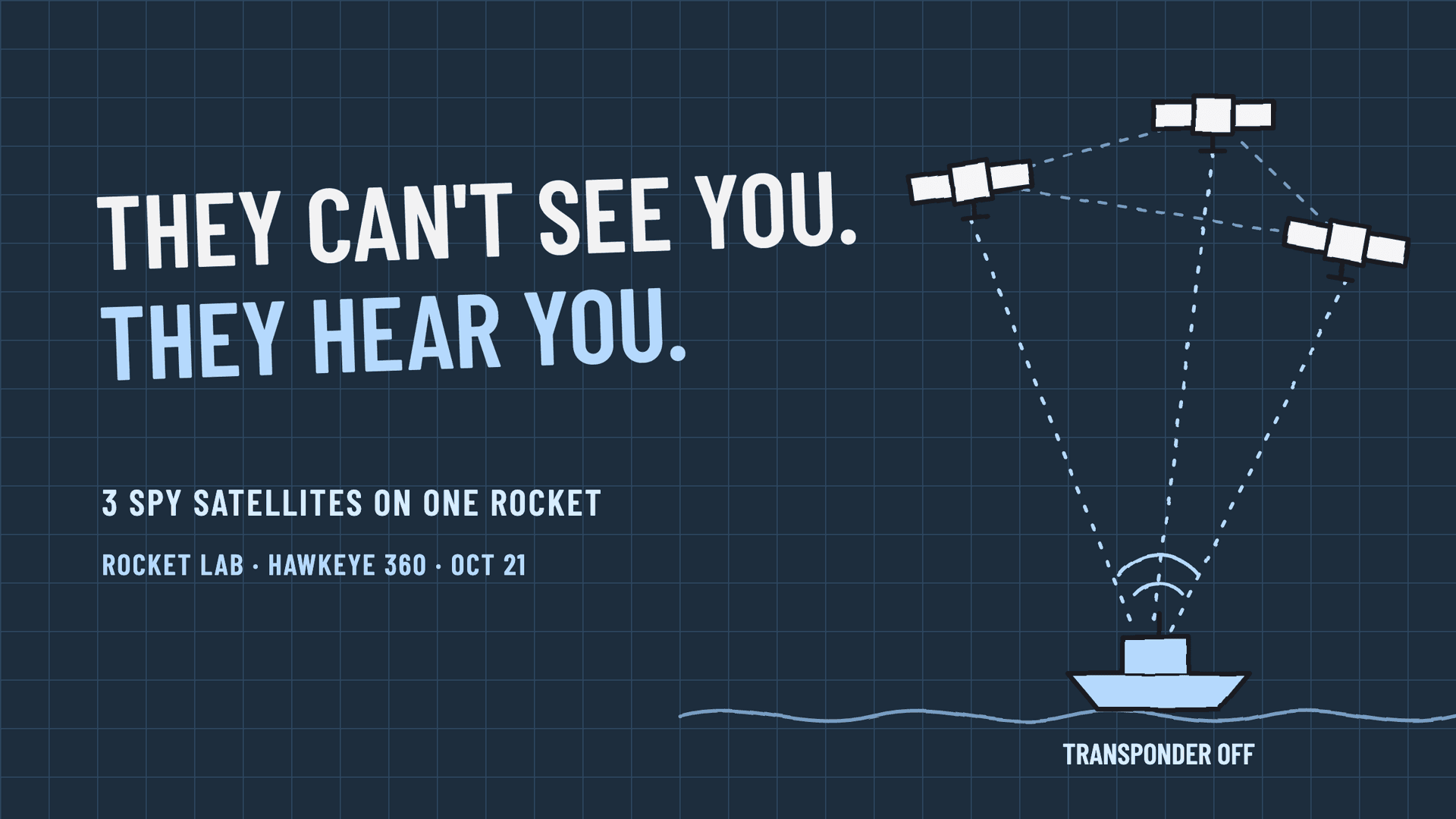
The payload is a single cluster of three satellites. According to Rocket Lab, they are heading to a 520 km sun-synchronous orbit at 97° inclination. These hawks don't take pictures; they listen. Three spacecraft fly in formation and pick up the same radio signal with tiny differences in arrival time, and from those differences the source can be located. That is how you spot a ship that has switched off its transponder, a GPS jammer in the Baltic or a radar someone would rather keep quiet. Rocket Lab lists maritime surveillance, GNSS jamming detection, radars, communications and space defence. Put more simply, it is signals intelligence sold as a service.
The satellites themselves are small. According to Canada's SFL, the previous cluster was built on the 30 kg DEFIANT platform at HawkEye's Virginia plant, to an SFL design. All three together weigh about as much as an average-sized person.
The taxi and the bus
The history between the two companies is bumpier than the jolly mission names suggest. In April 2022 HawkEye 360 picked Rocket Lab for three Electron flights carrying 15 satellites in five clusters. The first flight was to be a rideshare with three satellites, the other two dedicated with six each, all between late 2022 and 2024, according to the announcement at the time. Reality looks like this. Cluster 6 flew in January 2023 from Wallops, Virginia, as the first Electron launch from US soil. Cluster 12 flew in June 2025, brought forward because another mission had been delayed for extra checks, Nasdaq reported. If the current flight is the third under the same contract, it is nearly two years late, and the three flights together deliver 9 satellites instead of 15. Neither company has said whether the contract has been amended.
Meanwhile most clusters travel by other means. Of the first twelve, ten flew on Falcon 9, and Cluster 14 went up on the Transporter-16 rideshare, according to HawkEye 360. The logic is simple. Transporter is a bus with a fixed timetable and a cheap ticket; Electron is a taxi to the exact orbit at the exact time. HawkEye calls the taxi when it's in a hurry.
Who pays
| Who pays | To whom | For what | How much | Source |
|---|---|---|---|---|
| HawkEye 360 | Rocket Lab | The Electron launch | Not disclosed (the 2022 contract covers three flights) | Business Wire, Rocket Lab |
| US government | HawkEye 360 | RF data and analytics | 61% of 2025 revenue (~$71.8m) | HawkEye 360 S-1 |
| Customers in Japan | HawkEye 360 | Data and analytics | 16% of 2025 revenue (~$18.8m) | HawkEye 360 S-1 |
| IPO investors | HawkEye 360 | New capital | $416m at $26 a share | Via Satellite |
In short: HawkEye pays for the launch, and HawkEye is paid mainly by American taxpayers.
The customer's money
2025 was HawkEye 360's first profitable year. Revenue was $117.7m, up 74% on the previous year, and net profit was $2.7m, the S-1 shows. In May the company listed on the NYSE at the top of its range. Then came two quarters of identical revenue: $49.8m in the first and $49.8m again in the second, with a net loss of $15.3m for the second (Q1, Q2). The company has $503m in cash, no debt and a multi-year contract with the Indian Navy. Its full-year guidance is $215–220m.
The maths is awkward. After $99.6m in the first half, the second half has to deliver between $115.4m and $120.4m. That is roughly $58–60m a quarter, a jump of 16 to 21% after two flat quarters. The market evidently has its doubts: on 6 October the stock stood at $14.37 (Benzinga), about 45% below the IPO price.
So I don't think this mission will move the share price, even if everything goes perfectly. A new cluster means more frequent passes over the same spot, which makes for a better product, but not money in this quarter's results. HawkEye's real dates are elsewhere. One is the third-quarter results. The other is the expiry of the insider lock-up, probably in early November if it is the standard 180 days. Both come weeks after the hawks fly.